
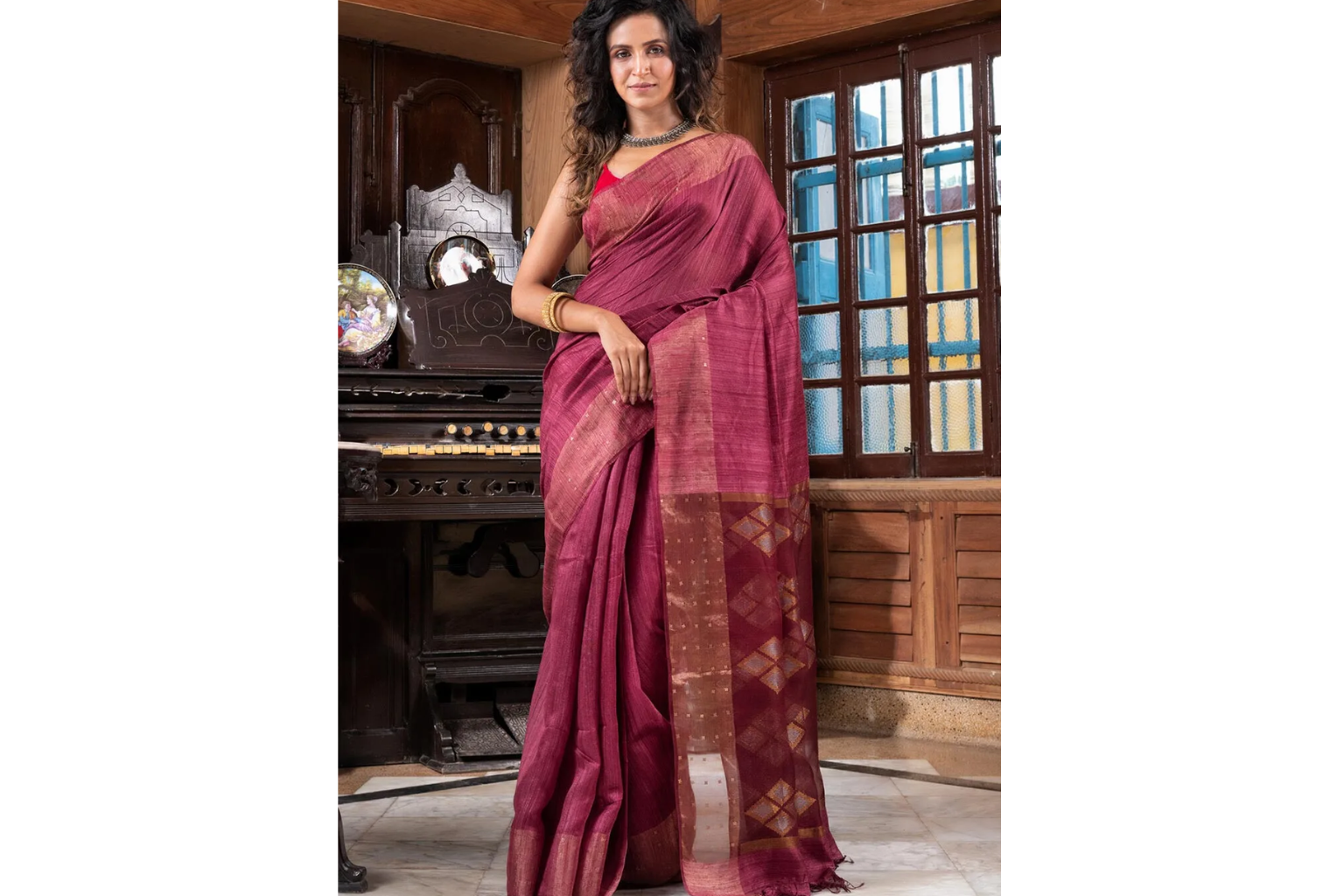
jamdani silk sarees
A Weave Rooted in Legendary Fineness
Jamdani belongs to a family of muslin weaving so fine that historical accounts describe pieces delicate enough to pass through a ring. Originating in the Dhaka region of undivided Bengal, the technique has long been practised on both sides of the present-day India-Bangladesh border, with West Bengal’s weaving clusters carrying forward the tradition using discontinuous weft weaving, where motifs are woven directly into the fabric rather than embroidered or printed afterward.
Woven In, Not Added On
This distinction matters more than it might seem. In a genuine jamdani silk sarees or cotton Jamdani, the design exists as part of the weave structure itself, created by manually manipulating extra weft threads at each point a motif appears. This is painstaking, slow work, often requiring two weavers working in coordination on a single loom, and it is precisely why authentic Jamdani carries a certain fineness that surface embellishment simply cannot replicate.
Recognising Genuine Jamdani
Checking the Reverse Side
One of the simplest ways to verify handwoven Jamdani is to examine the back of the fabric. Since the motifs are woven rather than printed, they should appear equally clear on both sides of the saree, whereas printed imitations will show the design crisply on the front and faintly, or not at all, on the reverse.
The Muslin Connection
Jamdani’s fineness traces directly back to the region’s older muslin traditions, and this lineage explains why the fabric is often compared to mulmul cotton sarees, another Bengal specialty known for its extremely fine, breathable weave. Both share a common ancestry in the pursuit of exceptionally light, sheer cotton, though Jamdani distinguishes itself through its woven-in patterning.
Wearing and Caring for Jamdani
Given how fine the base fabric usually is, Jamdani sarees require gentle handling, mild hand-washing, shade drying, and careful storage away from sharp jewellery that could snag the delicate weave.
A Craft Under Pressure
Jamdani weaving is time-intensive and increasingly practised by fewer artisan families, which has led to growing efforts, including UNESCO recognition of the craft, to document and safeguard the technique. Choosing a genuinely handwoven piece, even at a higher price than a printed imitation, directly supports the weavers keeping this exacting tradition alive.
Conclusion
Jamdani represents one of the more technically demanding weaving traditions still practised in India today, and its survival depends on continued appreciation from buyers who understand what goes into each piece. Those exploring India’s weaving traditions more broadly will find Jamdani a useful reminder of just how much skill can sit quietly within something as simple-looking as plain white cotton.