
digital marketing services
The resource allocation question is one of the hardest things about early-stage marketing. You have a limited budget, multiple channels competing for it, contradictory advice from advisors, investors, and blog posts, and the pressure of needing to show traction without having the resources that make traction easier to generate.
And the right answer — genuinely, honestly — depends heavily on your specific situation. So instead of a generic channel recommendation, this is a framework for thinking through where your first marketing dollars should go, based on what matters most for your specific stage, model, and timeline.
The Question Before the Budget Question
Before deciding where to spend, be honest about what you’re actually trying to accomplish with the spend. Early-stage marketing can serve several different purposes, and the right channel allocation depends on which purpose dominates.
Learning about your customers. At a very early stage, you don’t yet know exactly who responds to what message, which use cases are most compelling, and where your best-fit customers spend their attention. Marketing spend that generates this intelligence — even if conversion volume is low — is more valuable than spend that generates volume without insight.
Validating product-market fit signals. If you’re still in the phase of figuring out whether people actually want what you’re building, marketing spend that surfaces genuine customer response (or lack thereof) is research investment, not growth investment.
Generating initial revenue. Once product-market fit has some evidence, the goal shifts to generating paying customers as efficiently as possible to demonstrate commercial viability and extend runway.
Building the foundation for scalable growth. The organic channels — content and SEO, community, referral — take time to build but compound in ways that paid channels don’t. Investment in these channels early produces compounding returns that become increasingly valuable as the business scales.
Most early-stage startups are doing some combination of all four simultaneously, but one usually dominates — and that dominant purpose should shape the channel allocation.
What Paid Search Actually Does for Startups
Paid search (Google Ads, Bing Ads) has genuine utility for startups at specific stages, for specific reasons.
The most legitimate use of early-stage paid search is learning. Running ad campaigns against different keyword categories reveals which search intents are actually driving conversions, which landing page messages resonate, and which customer segments convert from search. This intelligence is genuinely useful for shaping both your product positioning and your organic search strategy.
The economics of paid search for startups are difficult to ignore. CAC from paid search in most categories is high and rising. For startups with limited runway, significant paid search spend can produce alarming CAC numbers that accelerate runway burn without producing sustainable acquisition economics.
The founders who use paid search most effectively at early stage are those who treat it explicitly as a learning and validation tool, cap the spend to what they can genuinely afford for the intelligence it generates, and don’t mistake paid traffic for a sustainable acquisition model.
The SEO Investment Argument for Startups
Most startup marketing advice underweights SEO relative to its long-term importance, because SEO doesn’t produce quick wins and the return timeline is misaligned with the urgency most startups feel.
But the compounding argument for early SEO investment is genuinely compelling for startups that have the time horizon to see it through.
The domain authority that you start building in month one is worth more to you in month eighteen than what you build in month fifteen. The topical authority you establish in your category before competitors do becomes increasingly hard to displace. The organic traffic that starts arriving in month eight, nine, ten continues arriving in month twenty, thirty, forty — without continued spend.
For startups with a genuine content angle — and most startups do if they think about it — the early investment in digital marketing services that include an SEO foundation produces an asset that gets more valuable over time, rather than a media buy that stops working the moment the spend stops.
This doesn’t mean all-in on SEO from day one. It means treating SEO investment as a consistent component of the marketing budget from early stage, not something to defer until the business is more established.
Social Media: Where Most Early-Stage Startups Waste Time
Social media often absorbs an outsized proportion of early-stage marketing effort relative to the return it produces.
The reasons are understandable: social media feels active and productive, it generates visible engagement signals, and the advice to “build an audience” and “be present on social” is nearly universal. But for most B2B startups and many consumer startups, the direct commercial return from social media presence — particularly in the first year — is minimal compared to the time investment.
The exception is founder-led social content that builds genuine credibility and generates enterprise-quality inbound. LinkedIn content from a founder with genuine expertise and perspective in their domain can produce meaningful sales pipeline. This works specifically when the content is genuinely insightful (not generic startup wisdom), the target customers are on LinkedIn, and the founder can sustain it consistently.
Twitter/X can work similarly in technical communities where genuine practitioners engage. Product Hunt, HackerNews, and community-specific platforms (Reddit communities, Slack groups, Discord servers) can drive meaningful early traffic and signal in specific markets.
The general-purpose Instagram and TikTok presence that many consumer startups build in early stage typically produces engagement without commercial impact. It’s not zero — brand awareness has value — but it’s often over-weighted relative to channels with more direct return.
Community and Referral: The Underrated Channels
For many B2B and prosumer startups, the highest-ROI early marketing activity is investment in the communities where target customers already spend time.
Not broadcasting in those communities. Participating genuinely — contributing useful knowledge, helping community members with real problems, being a recognisable and trusted presence. The commercial return from this kind of community investment is real and meaningful, particularly for SaaS and professional service startups whose buyers make decisions based heavily on peer recommendation.
Referral programmes — formally structured systems that incentivise customers to refer others — are often underdeployed by early-stage startups because building them feels like a distraction from other priorities. But the economics of referred customers are almost universally better: higher conversion rate, lower CAC, higher retention, higher average order value. Investing early in the referral infrastructure and actively encouraging referral behaviour produces compounding returns as the customer base grows.
Email: Still the Highest-Return Channel for Most Startups
Email consistently produces the highest commercial return per dollar invested of any digital channel, and it’s consistently underinvested by early-stage startups in favour of more visible channels.
An early focus on building an email list — from content downloads, free tool signups, event attendance, community engagement — creates an owned audience that can be communicated with directly without paying for reach. A list of 5,000 engaged early adopters who’ve explicitly opted in to hear from you is worth more to a startup than 50,000 social followers.
The combination of a modest paid advertising budget to drive list growth, genuinely useful email content that demonstrates expertise and builds relationship, and a conversion-oriented sequence for subscribers showing purchase intent is a high-efficiency marketing stack for most early-stage startups.
The Allocation Framework
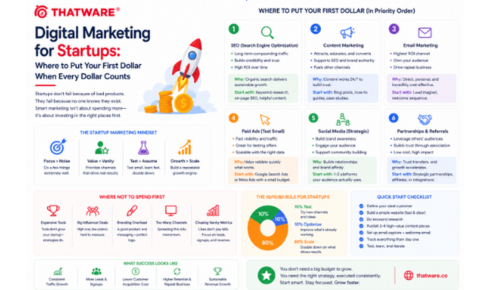
Given all of the above, here’s a practical starting point for early-stage digital growth agency thinking:
For B2B SaaS startups, a rough framework: 30-40% on content and SEO (articles, SEO foundation, linkable assets), 20-25% on paid search (for learning and validation, capped at what you can afford to lose), 15-20% on community and founder social, 10-15% on email infrastructure and content, and 10-15% on events or partnerships specific to your customer segment.
For consumer startups, the distribution shifts: more emphasis on the channels where your specific customers actually are, more on referral programme infrastructure, potentially more on influencer and community partnership relative to organic search.
For local service startups, local SEO and Google Business Profile optimisation deserve significantly more weight than in other models — it’s the highest-return activity for many local businesses and is chronically underinvested.
In every case, the actual allocation should be driven by the specific customer acquisition dynamics of your business rather than a generic framework. Where do your best current customers come from? What did it take to convert them? What would make it easier to replicate that? The answers to these questions are more valuable than any general channel guidance.
The Thing That Matters Most
Budget allocation matters. Channel selection matters. But the thing that determines whether early marketing spend works isn’t primarily about channels — it’s about clarity.
Clarity on who you’re selling to and what specific problem you’re solving for them. Clarity on what’s genuinely different about what you’re offering. Clarity on what a converted customer looks like and how you’ll know when marketing has worked.
Without that clarity, even well-allocated budgets produce muddled results. With it, even modest budgets can produce meaningful traction — because every dollar is pointed in the same direction at the same target.
The allocation questions become easier to answer well once the strategic clarity is there.