
pickleball cou rt builders
Pickleball is one of the fastest-growing sports worldwide, and with this growth comes a surge in demand for professionally built pickleball courts. Whether it’s a residential backyard, school, club, or community facility, one question always comes first: what is a pickleball court actually made of?
The short answer is the flooring system. While nets, posts, and markings matter, the real performance, safety, and durability of a court depend almost entirely on the pickleball court flooring.
This guide breaks down the 10 essential steps involved in pickleball court construction, with a clear focus on pickleball court material, flooring layers, and installation best practices, helping you understand where quality really matters.
Step 1: Selecting the Right Pickleball Court Flooring Type
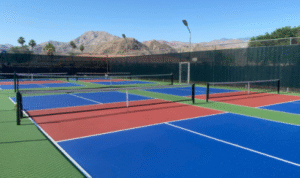
Every high-performance pickleball court starts with choosing the right pickleball court flooring. For outdoor courts, synthetic acrylic flooring systems are the most widely used and trusted option.
Acrylic pickleball flooring provides:
- Consistent ball bounce
- Excellent player grip
- UV and weather resistance
- Low maintenance over time
This is why most professional pickleball cou
rt builders rely on acrylic systems instead of tiles or temporary surfaces.
Step 2: Understanding the Base – Concrete or Asphalt
Before the pickleball floor is applied, a strong base is required. Typically, M20–M25 grade concrete is preferred for long-term durability, especially in Indian climate conditions.
A stable base ensures:
- No surface cracks are transferring to the top layer
- Even coating thickness
- Longer life of the pickleball court floor
The quality of the base directly impacts the cost of pickleball court construction in the long run.
Step 3: Surface Slope & Drainage Planning
One often-ignored but critical part of pickleball court construction is slope planning. The base is designed with a gentle slope to allow water runoff.
Proper drainage:
- Prevents water pooling
- Protects pickleball flooring layers
- Reduces maintenance costs
Without this step, even the best pickleball court material can fail prematurely.
Step 4: Primer Application – The Bonding Layer
Acrylic primer is the first coating applied over the base. Its role is to create a strong bond between the concrete and the pickleball flooring system.
This step ensures:
- Better adhesion
- Uniform absorption
- Long-lasting surface performance
Skipping or diluting the primer is a common mistake in low-budget pickleball court installation.
Step 5: Acrylic Resurfacer – Smoothing the Court
The resurfacer layer helps correct minor surface imperfections and creates a smooth, playable base for color coats.
A proper resurfacer:
- Levels micro cracks
- Improves bounce consistency
- Extends surface life
This step is essential for both commercial courts and those building a home pickleball court.
Step 6: Cushion (Optional but Recommended)
For enhanced comfort and injury reduction, cushion layers can be added to the pickleball court flooring system.
Cushioned pickleball floors:
- Reduce joint stress
- Improve player comfort
- Add premium value to the court.
While optional, this step is increasingly popular in academies and residential projects.
Step 7: Acrylic Color Coats – The Actual Playing Surface
This is the most visible and important part of pickleball flooring. Multiple acrylic color coats are applied to achieve the final playing surface.
High-quality pickleball court material ensures:
- Non-slip texture
- Fade resistance
- Stable ball response
This layer defines the real performance of the pickleball court floor.
Step 8: Texture Control for Grip & Safety
Silica sand is mixed into acrylic coatings to control texture. This determines how much grip players experience during play.
Proper texture:
- Prevents slipping
- Allows controlled movement
- Enhances player confidence
Texture calibration is a key reason experienced pickleball court builders outperform general contractors.
Step 9: Line Marking & Game Layout
Accurate line marking completes the playing area. Specialized acrylic line marking paint ensures high visibility and long life.
Correct markings:
- Meet standard pickleball dimensions
- Resist fading and peeling.
- Maintain clarity over the years.e
This step finalizes the pickleball court construction process.
Step 10: Final Inspection & Maintenance Planning
Before handover, the surface is inspected for:
- Uniform thickness
- Consistent bounce
- Proper drainage
Routine cleaning and periodic recoating help keep pickleball flooring in top condition for years.
Cost of Pickleball Court Construction: What Impacts It?
The cost of pickleball court construction depends mainly on:
- Base preparation quality
- Type of pickleball court flooring used
- Number of acrylic layers
- Cushioning requirements
- Installation expertise
Cutting corners on materials may reduce initial cost but significantly increase long-term repair expenses.
Building a Home Pickleball Court: What Changes?
For homeowners, building a home pickleball court requires the same flooring principles as professional courts just scaled to space and usage.
Acrylic pickleball flooring is ideal for home courts because it:
- Handles outdoor exposure well
- Requires minimal maintenance
- Delivers professional-level play experience
Why Top Flooring Matters for Pickleball Courts
When it comes to pickleball courts, flooring is not just one component—it is the foundation of performance, safety, and durability. Content that focuses on top flooring systems helps decision-makers understand:
- Why material quality matters more than aesthetics
- How professional pickleball flooring extends court life
- Why experienced pickleball court builders prioritize surface systems
Top flooring–focused content educates buyers, reduces misinformation, and promotes smarter investment decisions—especially in a growing sport like pickleball, where many first-time builders underestimate the importance of surface engineering.
Final Thoughts
So, what is a pickleball court made of? At its core, it’s made of a well-engineered pickleball court flooring system built layer by layer for performance and longevity.
From primer to color coats, every layer plays a role. Whether you’re planning a commercial facility or installing a backyard court, understanding the pickleball court material and flooring process ensures better results, safer play, and long-term value.